The review is for decisions, not reporting
A small pipeline does not need a long meeting or a dashboard built for a larger organization. It needs a reliable moment when open inquiries become understandable: what arrived, who owns it, what honest state it is in, and what happens next.
Fifteen minutes is a boundary, not a performance claim. The time box keeps the practice small enough to repeat. If the list cannot be reviewed in that time, the useful result is evidence that the records, scope, volume, or exceptions require a different process.
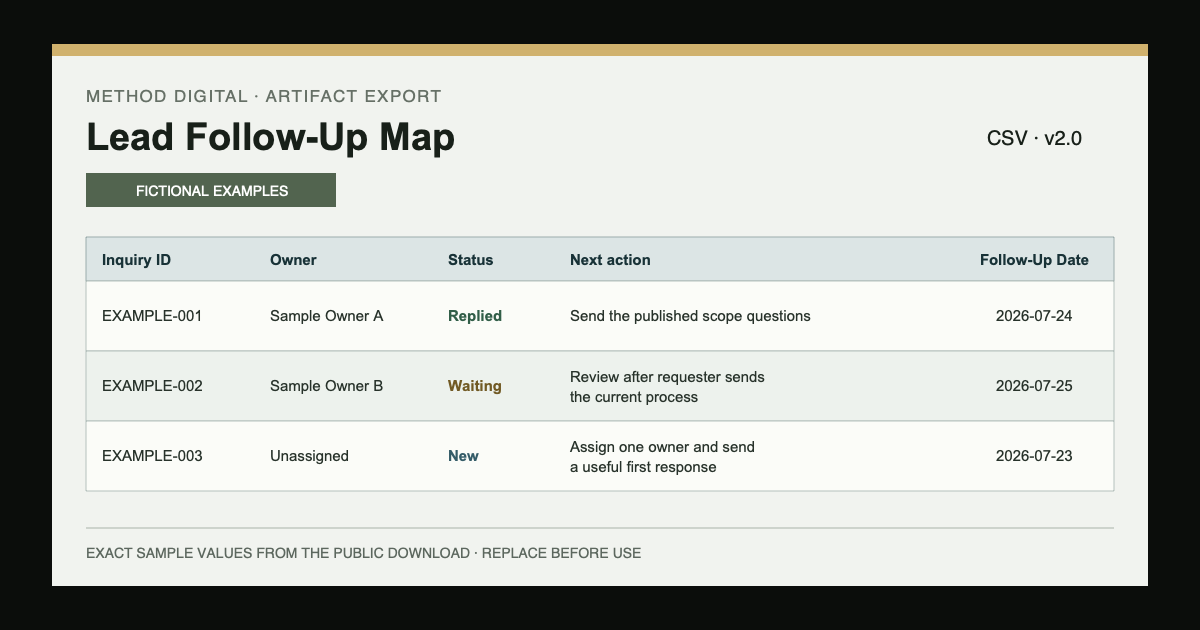
Use one source of truth. That may be the MethodCo Lead Follow-Up Map, another spreadsheet, or a customer-owned CRM. Do not spend the review reconstructing the list from several inboxes and private notes.
Minutes 0–3: collect the open truth
Filter or gather every inquiry that is not closed. Include new requests, items waiting on another person, promised replies, and anything with a follow-up date that has arrived. Do not add speculative opportunities or contacts who did not make a genuine inquiry.
Check for duplicates and obviously completed records. Close or merge them only when the evidence is clear. The goal is a list of real open commitments, not a larger pipeline that looks active.
- New records not yet reviewed
- Waiting records that still require a decision
- Due or overdue follow-up dates
- Open records without an owner or next action
Minutes 3–6: give every record one owner
Scan the owner field. Every open row needs one person who is responsible for moving it to its next honest state. “Team,” “inbox,” and “automation” are not owners. A tool can route or remind; it cannot accept accountability.
Reassign records only when the receiving person knows what is expected. If nobody is qualified or available to handle a request, the responsible action may be to decline it clearly rather than leaving it open.
Minutes 6–9: write the next physical action
Replace vague notes with one observable action. “Follow up” does not say what will be sent, why it is appropriate, or when the owner will review it. “Send the published scope questions” or “Review the requester’s current workflow after it arrives” can be checked.
Do not automate an action merely because it repeats. First confirm that the message is permitted, factually supported, inside the published scope, and appropriate for the current state. Unusual, sensitive, or consequential requests should return to a person.
Minutes 9–12: check dates, promises, and waiting states
A follow-up date is a review commitment, not permission to send indefinitely. When the date arrives, the owner decides whether another contact is appropriate, whether the record should stay waiting, or whether it should close.
Read any promise already made. Confirm that the stated price, timing, availability, deliverable, or next response is still true. If a promise cannot be kept, correct it directly rather than letting a reminder continue the wrong message.
Minutes 12–15: close, escalate, and record the finish
Close completed, declined, duplicate, withdrawn, or no-longer-active inquiries with a short factual outcome. Closing a record is not the same as deleting it; retention and deletion should follow the operator’s legitimate requirements rather than an arbitrary habit.
Escalate anything that needs a scope decision, access approval, privacy review, exception, or consequential judgment. Record the named person and next review point. The fifteen-minute review should surface difficult work, not hide it inside an ordinary status.
Review the pattern after the rows
When time remains, look for repeated friction. Several incomplete requests may indicate that the page or form is unclear. Repeated out-of-scope inquiries may mean the service boundary is buried. Frequent missing ownership may mean the intake destination is wrong.
Treat these as observations, not proof of a cause. Record the pattern and inspect the source before changing the website, adding fields, or building automation. One visible recurring problem is a better starting point than a general desire to optimize the pipeline.
Keep the system proportionate
A spreadsheet can be enough for a small, low-complexity workflow when access, ownership, review, and retention are controlled. It may not be enough for high volume, regulated records, complex permissions, automated messaging, or work where errors are difficult to repair.
Adding a CRM does not remove the need for a named owner, explained statuses, truthful messages, and review. Choose the smallest system that can carry the real responsibility, then document how a person operates it when an integration fails.
Limitations and disclosure
This review is a general practice based on MethodCo’s published weekly-review guide and Lead Follow-Up Map. It is not a sales methodology, legal or privacy advice, a CRM implementation, a promise of response or revenue improvement, or evidence from customer results.
The operator remains responsible for consent, outreach rules, access, retention, security, each promise, and each decision to contact or close. Adapt the fields and review rhythm to the real requirements of the organization.
Next action: run one honest review
Download the review sheet, set a fifteen-minute timer, and use one real source of truth. Record the count of open rows only to make the session understandable, not to publish a performance claim. Finish with one owner, one next action, and one review date on every open record.
If the timer ends before the list is clear, stop and write why. Missing fields, too many sources, uncertain ownership, or unresolved exceptions are findings. Repair the structure before asking a tool to move the same confusion faster.